DigitalOcean
Buy Digital Ocean Account
Clean interfaces, straightforward droplets or Kubernetes clusters, and transparent pricing.
From $25
5 options
UpCloud is a European cloud provider known for high-performance Cloud Servers, proprietary MaxIOPS storage technology, transparent pricing, and zero-cost egress under its Fair Transfer Policy.
Independent listing. Prices shown are the marketplace prices for each option; the provider's own usage charges apply separately under its terms.
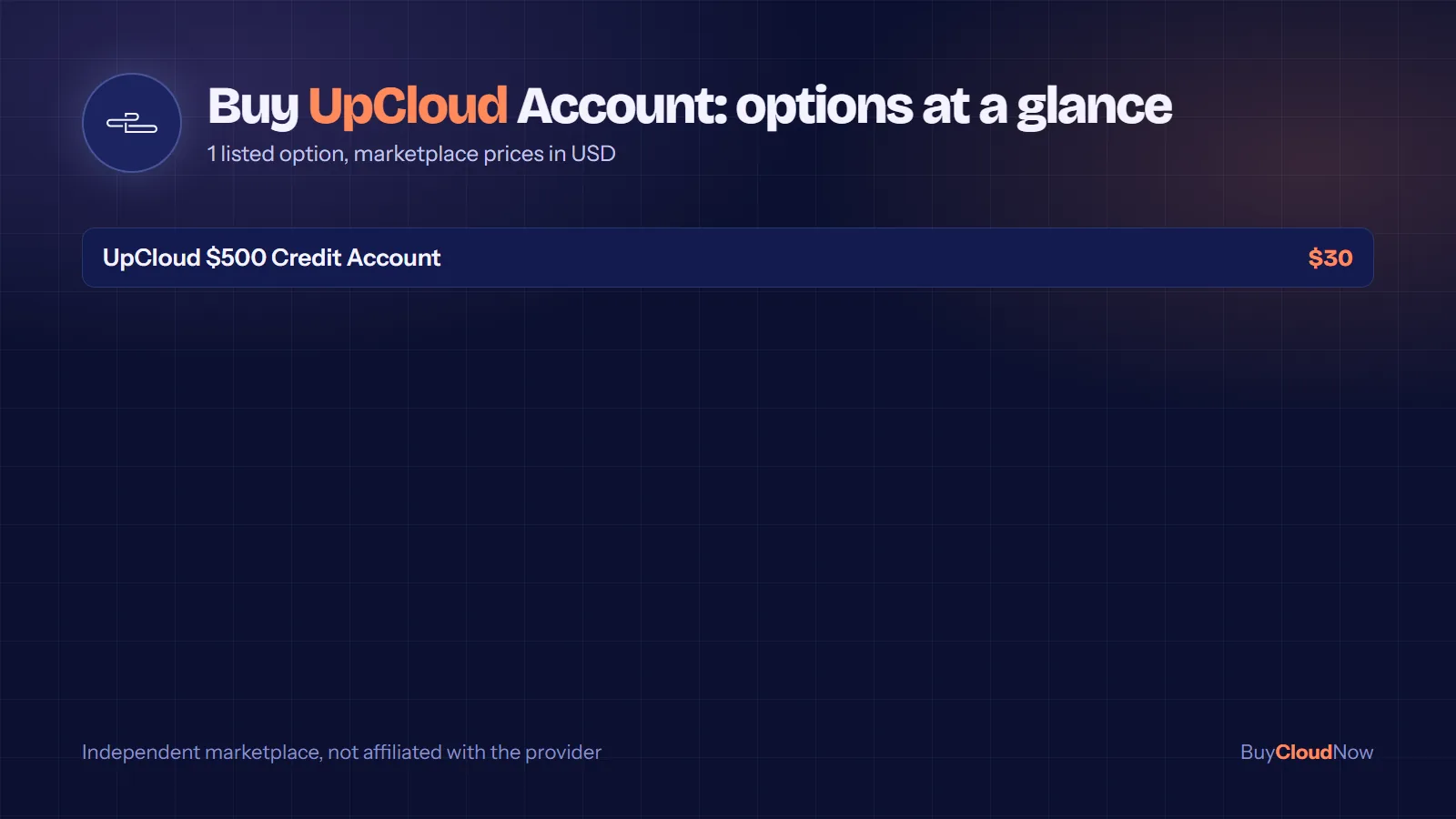
Buy UpCloud Account listings offer a $500 Credit Account at $30 on a performance-focused European cloud with global reach.
UpCloud is known for its Cloud Servers and MaxIOPS storage. This page explains the option, the platform fundamentals, and what to confirm before you start deploying workloads.
These are the 1 option currently listed for Buy UpCloud Account, with the marketplace price for each. Prices are in US dollars and apply to the listing itself; the provider’s own usage charges apply separately under its terms of service.
Select an option in the purchase panel at the top of this page to see its price update, then add it to the cart. If you need a configuration that is not listed, message the team through the contact page.
UpCloud is a European cloud provider known for high-performance Cloud Servers, proprietary MaxIOPS storage technology, transparent pricing, and zero-cost egress under its Fair Transfer Policy. Developers, startups, and businesses that prioritize consistent I/O performance, fast deployment times, and predictable billing often look for ways to Buy UpCloud Account access when they need promotional credits, accounts that have already completed verification, or configurations ready for production use.
This page explains how UpCloud accounts work, the configurations people commonly seek, practical evaluation factors, typical use cases, and answers to frequent questions. The information is intended to help you understand the landscape so you can decide whether acquiring an account aligns with your project needs and risk tolerance.
At BuyCloudNow.com we operate as a marketplace-oriented destination where visitors can review available cloud-account listings, including those related to UpCloud. The content below focuses on genuine user considerations rather than promotional claims.
An UpCloud account provides access to the control panel (hub.upcloud.com), API, and the full range of services: Cloud Servers, Block Storage (MaxIOPS, Standard, and Archive tiers), Managed Databases, Managed Kubernetes, Object Storage, Load Balancers, networking features, and GPU Servers. Sign-up typically involves email confirmation and payment-method verification. New users are often offered a free trial period with limited quotas; upgrading requires a minimum deposit, after which full access and any applicable promotional credits become available.
Billing is hourly for most resources, with monthly caps on certain plan types to keep costs consistent regardless of the number of days in the month. Zero-cost egress is a core feature, subject to the Fair Transfer Policy. Deployment of new Cloud Servers is optimized to complete in approximately 45 seconds. Service-level agreements reach up to 99.999% on eligible products.
Account quotas limit the number and size of resources that can be created, especially during trial periods. These practical constraints explain why some teams look for an UpCloud Account for Sale that already carries usable credits or has progressed past the most restrictive new-account stage.
Creating an account through the official UpCloud sign-up flow is straightforward for most people. Friction appears in several real-world situations:
In these cases people search for ways to Buy UpCloud Cloud Account options that already address one or more of those constraints. An UpCloud Account with Credits can reduce cash outlay during prototyping. An UpCloud Cloud Server Account that has already cleared initial limits can shorten the path from acquisition to first deployment. An UpCloud Managed Cloud Account that includes access to higher-tier managed services can remove extra approval steps.
Promotional credits and trial balances are applied against eligible usage before a payment method is charged. An UpCloud Account with Credits may carry a remaining promotional balance from a new-customer offer or another legitimate source.
When evaluating such an account, buyers typically examine:
An UpCloud Credit Account is useful for teams that want to run meaningful workloads without immediate cash cost. Buy UpCloud Credits in the form of a pre-funded account can support proof-of-concept work, performance testing of MaxIOPS storage, or bridging periods while longer-term arrangements are negotiated. Credits function as a draw-down pool; once the balance reaches zero the account continues under ordinary rates if a valid payment method remains attached.
It is important to verify coverage and remaining validity. Official promotional terms treat credits as time-limited. Always confirm the exact balance and expiry after any transfer.
Cloud Servers are UpCloud’s core virtual-machine product. An UpCloud Cloud Server Account generally refers to an account oriented toward deploying and managing these instances. Related terms include UpCloud VPS Account, UpCloud Server Account, and UpCloud Compute Account. These phrases usually point to accounts suited to general-purpose virtual machines rather than specialized managed or GPU workloads.
Plan families include Starter (cost-effective for development), Premium (MaxIOPS storage and higher SLA), and Cloud Native (modular pricing designed for Kubernetes and fluctuating workloads). Evaluation points typically include:
An UpCloud Cloud Server Online listing usually highlights that servers can be launched immediately through the control panel or API after transfer. An UpCloud VPS Cloud Account is another way buyers describe accounts focused on virtual-server capacity.
Beyond raw compute, UpCloud offers managed services that reduce operational overhead. An UpCloud Managed Cloud Account emphasizes access to Managed Databases (MySQL, PostgreSQL, Valkey, OpenSearch), Managed Kubernetes, Managed Object Storage, and Managed Load Balancers. These services handle backups, failover, and routine maintenance so teams can focus on applications rather than infrastructure operations.
Evaluation points for managed-oriented accounts include:
An UpCloud Cloud Hosting Account or UpCloud Hosting Account is often sought by teams that combine Cloud Servers with managed databases and load balancing for complete application stacks.
Some teams need a full infrastructure foundation rather than isolated servers. An UpCloud Infrastructure Account or UpCloud Cloud Infrastructure Account provides readiness across compute, storage, networking, and managed services. These accounts are often chosen by organizations that plan multi-tier environments or want a single billing relationship for a broader stack.
An UpCloud Account for Developers is frequently sought by individual engineers or small teams who want an isolated environment separate from employer or client billing. Features that matter in this context include clean API access, straightforward control-panel navigation, and cost-visibility tools so individual developers stay within limits.
An UpCloud Account Online listing usually indicates that the account can be accessed immediately through the hub and API after transfer.
Startups and early-stage product teams often need to validate ideas quickly while conserving cash. An UpCloud Account with Credits lets them provision Cloud Servers, test MaxIOPS performance, and run managed databases during the critical early phase. The 45-second deployment time and zero-cost egress help keep experimentation friction low.
Agencies and consultancies manage multiple client projects that require clean billing separation. Separate UpCloud Cloud Account instances help isolate cost and access. An UpCloud Hosting Account or UpCloud Server Account can be assigned to a specific engagement and closed or transferred when the work ends.
Researchers and technical teams frequently require consistent high-IOPS storage or GPU capacity for data processing and model work. An UpCloud Compute Account with MaxIOPS storage or access to GPU Servers can support these workloads without long procurement cycles.
Established businesses may need temporary additional capacity during peak periods, migrations, or disaster-recovery testing. An UpCloud Cloud Infrastructure Account that already carries higher quotas reduces the risk of delays caused by verification or limit-increase steps.
Individual developers and freelancers sometimes prefer an independent UpCloud Account for Developers rather than relying on an employer’s account. This keeps personal experiments portable and cleanly separated from professional resources. Transparent hourly billing and the Fair Transfer Policy make cost control straightforward.
Purchasing an UpCloud account from a third party involves responsibilities that buyers must evaluate carefully.
Terms of service and transferability
Official promotional credits and trial benefits are generally non-transferable and restricted to new eligible customers. Accounts are intended for the party that created them. Buyers should review the current terms and understand that UpCloud retains the ability to suspend accounts that appear to have changed ownership under suspicious circumstances or that violate eligibility rules.
Credit authenticity
Request clear evidence of the current credit balance, its origin, and its expiration. An UpCloud Credit Account is only as useful as the balance that remains after any transfer.
Quota verification
Confirm current limits on Cloud Servers, storage devices, managed services, and any GPU resources. Control-panel or API evidence is the most reliable confirmation.
Security hygiene after transfer
Immediately change the password, enable any available multi-factor options, review API keys and SSH keys, and examine all existing resources. Remove unknown servers, storage devices, or access paths.
Billing continuity
Ensure a payment method can be attached or updated so services continue once credits are exhausted. Understand any existing spending alerts or deposit requirements.
Support eligibility
Determine how 24/7 support tickets will be handled after the change of control and whether the account retains full support access.
These steps help reduce operational and compliance risk.
Pricing is designed for predictability: resources are billed hourly (with monthly caps on certain plans), egress is zero-cost under the Fair Transfer Policy, and the control panel provides clear visibility into usage. The first payment on a new account often includes a money-back guarantee window.
Common optimization approaches include:
An account that already carries credits provides a temporary buffer while these longer-term controls are put in place.
A structured approach reduces the chance of post-purchase surprises.
It usually refers to obtaining an UpCloud account that is ready for resource creation, sometimes with remaining promotional credits or higher quotas already in place.
No. Official trial accounts follow current promotional terms and verification requirements. Marketplace accounts vary in history, credit balance, and configuration.
Some listings are positioned as UpCloud Managed Cloud Account or UpCloud Cloud Server Account offerings that have previously cleared higher limits. Always confirm current accessibility after transfer.
Confirm the exact remaining balance, the expiration window, and which services the credits can be applied to. Also verify that the account has not already exhausted the credits.
The practical difference is usually the presence of higher quotas or already-cleared verification. Functionally it remains a normal UpCloud account, but the configuration may favor immediate deployment of multiple Cloud Servers.
Official policy generally treats promotional credits and trial benefits as non-transferable. Any secondary-market transaction carries risk that buyers must evaluate.
These phrases are used interchangeably by buyers searching for accounts suited to virtual-machine workloads. Focus on the actual quotas and regional availability rather than the marketing label.
Yes. MaxIOPS storage is available on eligible plans and delivers high read and write performance. Confirm the storage tier and regional availability.
BuyCloudNow.com operates as an independent marketplace for cloud-related accounts and services. Buyers should perform their own due diligence on any listing.
If a valid payment method is attached, services continue under standard rates. Without a payment method, resources may be restricted according to platform policies.
Once credentials are transferred and you have secured the account, you can typically begin creating resources immediately, subject to existing quotas. New Cloud Servers often become available in approximately 45 seconds.
Changing recovery options is a common post-purchase step for security. Confirm with the seller whether the current recovery methods allow a clean change of control.
Yes. Cloud Servers support a wide range of Linux distributions and Windows Server images. Supporting services such as block storage and load balancers work across stacks.
Request control-panel screenshots or exports showing current credit balance, quotas, and confirmation that the account was created through legitimate channels.
These phrases are largely interchangeable. Both emphasize broader platform readiness beyond single servers. Focus on the actual services and quotas available.
MaxIOPS is UpCloud’s high-performance block storage technology. Zero-cost egress is offered under the Fair Transfer Policy; review the current policy details for any fair-use considerations.
Use these pages to compare providers, read background guides, and check the questions other buyers ask before deciding to buy upcloud account.
For platform features, quotas and current provider terms, the authoritative source is the official UpCloud documentation. Buy Cloud Now is an independent marketplace and is not affiliated with the provider.
Choosing to Buy UpCloud Account access is a practical decision for teams facing time, verification, or credit constraints. The value lies in matching the account’s actual capabilities—credits, quotas, regional presence, and configuration—to your specific workloads. An UpCloud Account for Sale can accelerate projects when the transfer is transparent and the remaining resources are clearly documented.
At the same time, responsible buyers treat every transaction with the same care they would apply to any significant infrastructure decision. Verify ownership, secure the account immediately, attach your own billing controls, and operate within UpCloud’s terms of service.
Whether you need an UpCloud Cloud Server Account for general virtual machines, an UpCloud VPS Account for flexible compute, an UpCloud Managed Cloud Account for higher-level services, an UpCloud Hosting Account for applications, or a general-purpose UpCloud Cloud Account, the key is clarity about what you are acquiring and how you will manage it going forward.
If you are ready to explore current options that align with your requirements, review the listings available through BuyCloudNow.com and examine the details of each account carefully. Clear communication with the seller and thorough post-purchase security steps will help you move from acquisition to productive use with confidence.
UpCloud continues to evolve its Cloud Server plans, MaxIOPS technology, managed services, GPU offerings, and regional footprint. Staying informed through official documentation, billing best practices, and security recommendations remains the most reliable way to extract long-term value from any account you operate.
Clean interfaces, straightforward droplets or Kubernetes clusters, and transparent pricing.
Strong price-to-performance ratios, European data centers, and generous traffic allowances on many plans.
European data residency, developer-friendly tooling, and a mix of compute, storage, and related services.
Short answers from the Cloud FAQ hub for this provider, with links to the full set.
All UpCloud questionsUpCloud is a European cloud provider with a reputation for performance. Its Cloud Servers run on MaxIOPS, UpCloud’s proprietary high-performance block storage, and egress is zero-cost under its Fair Transfer Policy. The platform also offers Standard and Archive storage tiers, Managed Databases (MySQL, PostgreSQL, Valkey, OpenSearch), Managed Kubernetes, Object Storage, Load Balancers and GPU Servers, managed from hub.upcloud.com or the API.
It appeals to developers and startups that need consistent I/O for databases and busy applications, businesses that want European roots with global data centers, and agencies that value predictable hourly billing with monthly caps. See the Buy UpCloud Account page and UpCloud accounts: a performance-focused European cloud.
The Buy UpCloud Account page lists one option: the UpCloud $500 Credit Account at $30. It is described as an account that has moved past UpCloud’s limited trial stage and carries a $500 promotional balance. The balance is applied to eligible usage, such as Cloud Servers, MaxIOPS block storage, managed databases and load balancers, before any charge reaches your payment method; when it is used up, billing continues at UpCloud’s standard hourly rates with monthly caps on certain plans.
Promotional credit is time-limited under UpCloud’s terms, so confirm the remaining amount and expiry in the control panel. It suits performance testing, proof-of-concept builds and bridging a launch. Details are on the Buy UpCloud Account page; see UpCloud vs DigitalOcean accounts for a comparison.
In the control panel, confirm the account has been upgraded beyond the trial stage, note the remaining credit and its validity window, and make sure a payment method is attached so servers are not restricted when the balance ends. Check quotas on Cloud Servers, storage devices, managed services and GPU Servers; trial-stage accounts are the most restricted. Choose the data center that matches your users and any residency requirement.
Decide on storage tiers up front: MaxIOPS for performance, Standard or Archive for cost. Review the Fair Transfer Policy so zero-cost egress is not misread as unlimited under all conditions. Rotate API and SSH keys, change the password, enable multi-factor options, and read UpCloud’s terms. Start at the Buy UpCloud Account page, then apply monitoring and alerting first steps.
MaxIOPS is UpCloud’s proprietary block storage technology, built to deliver high and consistent read and write throughput to Cloud Servers. It is the storage behind Premium plans and the reason UpCloud positions itself around performance rather than the lowest headline price. Consistent I/O matters for databases, search indexes, busy web backends and CI runners, where noisy or throttled disks show up as latency.
UpCloud pairs this with fast server deployment, private networking, floating IPs and a Fair Transfer Policy that removes egress from the bill. Plan families reflect the focus: Starter for development, Premium for MaxIOPS and a higher service-level commitment, and Cloud Native for modular Kubernetes-style pricing. Read UpCloud accounts: a performance-focused European cloud, or view the Buy UpCloud Account page.
Teams running I/O-heavy or latency-sensitive workloads benefit most: SaaS backends with busy databases, e-commerce stacks, search and analytics services, and CI pipelines that hammer disk. European companies that want a provider with European roots, plus data centers elsewhere, use it for residency and proximity. Startups appreciate hourly billing with monthly caps and zero-cost egress, which keeps cost modeling simple.
Agencies run separate accounts per client with managed databases and load balancers to reduce operations work. Research teams with GPU needs can use GPU Servers. Teams that want hundreds of managed services or a serverless-first platform would look to a hyperscaler instead. Read European data residency cloud providers, and see the Buy UpCloud Account page.
Select an option above to add it to your cart, or message the team for a custom configuration.