OVHcloud
Buy OVH Account
European infrastructure with a broad product range from dedicated servers to public cloud.
From $30
2 options
European cloud infrastructure has become a strategic choice for teams that prioritise data sovereignty, renewable energy, and a complete ecosystem of compute, storage, networking, and AI services.
Independent listing. Prices shown are the marketplace prices for each option; the provider's own usage charges apply separately under its terms.
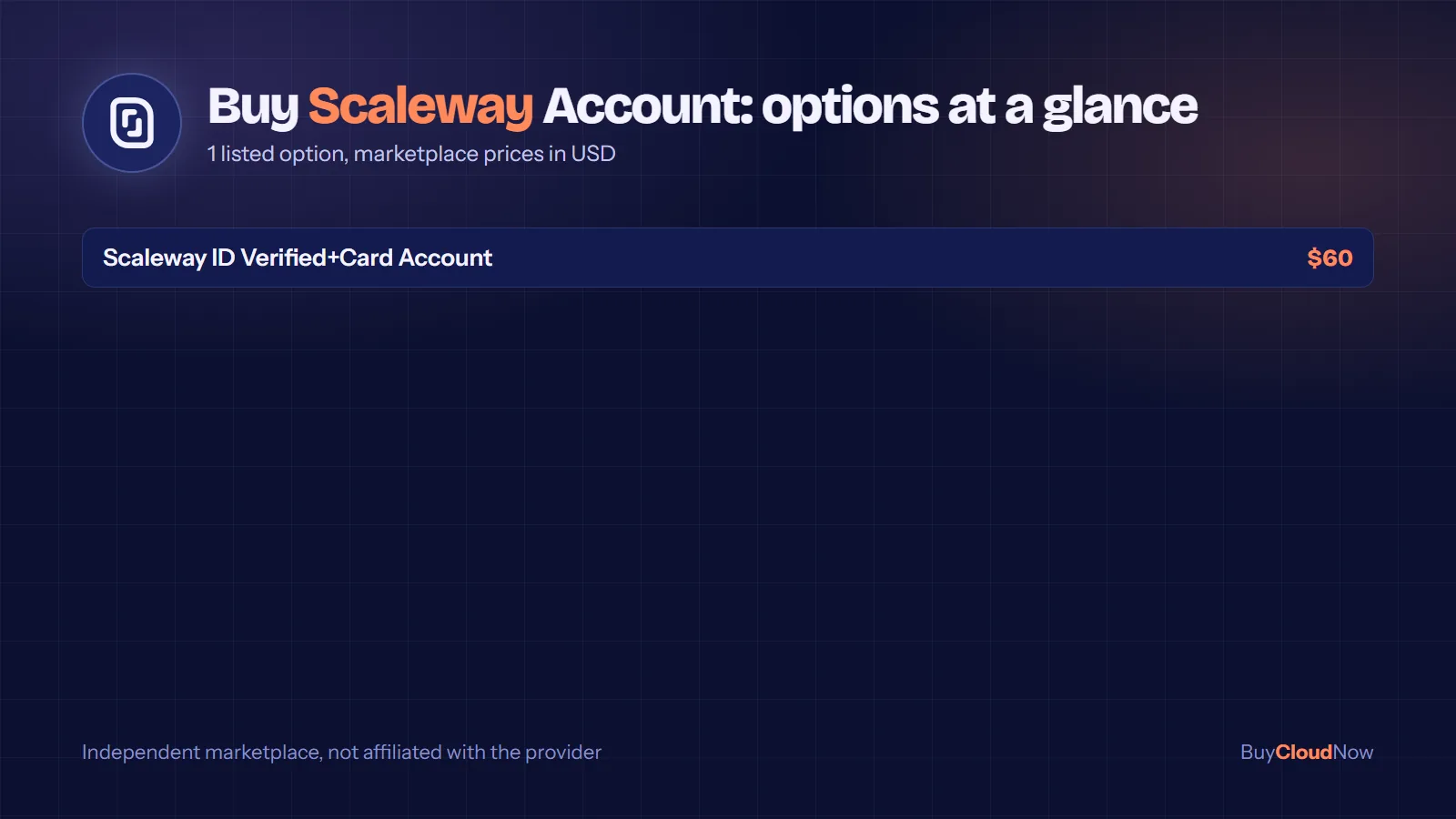
Buy Scaleway Account listings offer the ID Verified plus Card Account at $60 on Scaleway, a European provider chosen for data residency and developer-friendly tooling.
This page covers the listed option, Scaleway capabilities from instances to bare metal and GPU, and the steps to take once access is in hand.
These are the 1 option currently listed for Buy Scaleway Account, with the marketplace price for each. Prices are in US dollars and apply to the listing itself; the provider’s own usage charges apply separately under its terms of service.
Select an option in the purchase panel at the top of this page to see its price update, then add it to the cart. If you need a configuration that is not listed, message the team through the contact page.
European cloud infrastructure has become a strategic choice for teams that prioritise data sovereignty, renewable energy, and a complete ecosystem of compute, storage, networking, and AI services. When organisations decide to Buy Scaleway Account, they gain entry to a French-rooted platform that operates multi-availability-zone regions across Paris, Amsterdam, and Warsaw. BuyCloudNow.com helps developers, startups, agencies, researchers, SaaS teams, and businesses locate ready pathways so they can begin deploying resources without unnecessary administrative friction.
Scaleway offers a broad catalogue that includes virtual Instances, Elastic Metal bare-metal servers, GPU-accelerated machines, managed Kubernetes, object storage, managed databases, and specialised AI offerings such as Managed Inference. Many technical users look for a Scaleway Account for Sale when they need immediate console access, an isolated environment, or an account already prepared with promotional balances. This page examines the practical reasons for obtaining such an account, the services it unlocks, important evaluation points, realistic use cases, and answers to questions that commonly arise before purchase.
The account is the administrative identity that grants access to the console and API. Once credentials are in place, users can create Projects, provision Instances or bare-metal servers, attach storage, configure private networks, and explore GPU or AI resources. Understanding this gateway role helps set accurate expectations and supports informed decisions.
Data location and legal jurisdiction influence long-term risk assessments for many organisations. Scaleway’s infrastructure remains within the European Union, which aligns with GDPR requirements and reduces exposure to extraterritorial legislation. Teams that choose to Buy Scaleway Cloud Account frequently cite sovereignty, multi-AZ resilience, and a developer-friendly experience as primary motivations.
Regions in Paris, Amsterdam, and Warsaw each contain multiple Availability Zones. This design supports high-availability architectures without forcing workloads outside Europe. For applications serving European users, the combination of local latency and jurisdictional clarity is often decisive.
Sustainability forms another dimension of the platform’s positioning. Data centres powered by renewable energy and designed with attention to power usage effectiveness appeal to organisations tracking environmental impact. Transparent reporting on energy metrics allows teams to incorporate infrastructure choices into broader responsibility goals.
The product range spans development-friendly Instances, production-oriented general-purpose machines, high-memory or high-CPU configurations, bare-metal servers that integrate with the cloud ecosystem, and a growing suite of GPU and AI services. An account that already exists within this ecosystem can accelerate projects ranging from simple web applications to large-scale model training.
Creating a new account involves registration, identity verification where required, addition of a payment method, and any internal reviews. For some users the process is straightforward; for others it introduces delays. A Scaleway Account for Sale can shorten the path to console access, delivering credentials that allow immediate exploration of available services.
Isolation is a frequent practical reason. Agencies managing multiple client projects often prefer separate administrative domains. Development, staging, and production environments may be kept in distinct accounts to limit the impact of configuration errors or security incidents. Temporary experimental work can be confined to an account that is later closed. In each of these scenarios the ability to Buy Scaleway Account provides a clean boundary.
Promotional balances are another common attraction. A Scaleway Account with Credits or a Scaleway Credit Account can offset early usage costs, giving new users room to test Instance sizes, storage configurations, or GPU resources before larger financial commitments. Users who specifically Buy Scaleway Credits seek accounts that already contain usable balances applied to eligible services. The exact amount, validity period, and eligible products should always be confirmed at the time of acquisition.
Security remains the buyer’s responsibility after delivery. Changing the initial password, enabling multi-factor authentication, reviewing any pre-existing users or API keys, and configuring Identity and Access Management policies are essential first steps. A well-prepared account should support these hardening measures without restriction.
A Scaleway VPS Account centres on virtual Instances that function similarly to traditional virtual private servers while benefiting from cloud-native features. Development Instances suit testing and lightweight workloads. General-purpose configurations support production applications. Specialised ranges address compute-intensive or memory-intensive needs.
Users who elect to Buy Scaleway Cloud Account often begin with a modest Instance and expand capacity as requirements become clearer. Full root or administrative access enables installation of any compatible software stack. Block storage volumes can be attached, resized, and managed independently. Snapshots and backups provide recovery points that can be restored or used to clone environments.
A Scaleway Compute Account emphasises adjustable processing resources. Hourly billing with monthly caps on many products helps keep costs predictable. Private Networks and Security Groups allow fine-grained control over traffic between Instances and external networks.
A Scaleway Cloud Server Account expands the virtual-server model into broader cloud-oriented deployments. Multiple Instances can run under one identity, connected via Private Networks when isolation between public and internal traffic is required. Object Storage offers S3-compatible durability for static assets, backups, and large datasets. Managed databases reduce operational overhead for PostgreSQL, MySQL, and related engines.
Scaleway Cloud Infrastructure Account and Scaleway Infrastructure Account refer to accounts oriented toward multi-service designs that combine compute, storage, networking, and managed services into cohesive environments. Kubernetes Kapsule provides managed container orchestration. Serverless options support event-driven architectures. The same account can host both traditional Instances and more modern cloud-native components.
When virtualisation overhead or noisy-neighbour concerns become relevant, bare-metal options become attractive. A Scaleway Bare Metal Account grants access to Elastic Metal servers that deliver dedicated hardware while integrating with the broader cloud ecosystem. These servers suit latency-sensitive applications, large databases, and workloads that require consistent performance without shared tenancy.
An Scaleway Server Account in this category may combine bare-metal capacity with virtual resources, allowing hybrid designs that mix exclusive hardware with elastic Instances. Private networking and additional IP addressing support complex routing and multi-tier architectures.
Machine learning, inference, rendering, and scientific computing frequently require GPU acceleration. A Scaleway GPU Account provides access to Instances equipped with modern NVIDIA cards ranging from entry-level options to high-end H100 and newer architectures. These resources can dramatically reduce training and inference times.
A Scaleway AI Account extends this focus into managed services such as Managed Inference, which offers dedicated GPU infrastructure for serving curated or custom models with predictable performance. Custom-built clusters and on-demand GPU capacity expand the range of feasible large-scale training projects. Because GPU resources are typically billed according to usage, they pair well with accounts that already contain credits or have flexible payment methods.
A Scaleway Hosting Account or Scaleway Cloud Hosting Account can support websites, applications, and multi-site environments while still offering the underlying flexibility of virtual and bare-metal resources. Optional control-panel or one-click application options simplify common deployments for users who prefer reduced operational overhead.
Those seeking prompt usability often prefer a Scaleway Account Online that can be accessed shortly after credentials are delivered. The same preference applies when the priority is rapid login and service management rather than extended setup procedures.
An Scaleway Account for Developers frequently serves as a clean sandbox separate from production systems, allowing experimentation with Instances, containers, serverless functions, or GPU resources without affecting primary workloads.
Time savings rank among the most frequently cited advantages. Instead of completing every registration step and waiting for verification, users receive credentials and can begin provisioning resources almost immediately. For projects with tight deadlines or unexpected capacity needs, this difference is material.
Isolation and organisational hygiene form another benefit. Separate accounts reduce the risk that one project’s configuration or traffic will affect another. Client environments can be kept administratively distinct. Temporary or experimental work can be confined and later retired without affecting primary systems.
A Scaleway Account with Credits or the ability to Buy Scaleway Credits can lower the barrier to initial experimentation. Promotional balances applied to eligible services give teams room to test Instance sizes, storage configurations, GPU options, or managed services before larger financial commitments are made.
Security remains non-negotiable. Upon receiving credentials, the new holder should immediately update the password, enable multi-factor authentication, audit any pre-existing users or API keys, and review Identity and Access Management settings. These steps convert a delivered account into a hardened operational identity.
Clarify the primary purpose of the account. Lightweight websites and development sandboxes place different demands on CPU, memory, and storage than databases, continuous-integration systems, multi-server applications, or AI training jobs. Matching the intended use to available resource options prevents later resizing friction or under-provisioning.
If virtual Instances are the focus, confirm region and Availability Zone availability, operating-system choices, and backup options. For multi-server designs, examine Private Network capabilities and Security Groups. GPU or AI workloads require verification of available accelerator types and regions. Bare-metal projects benefit from reviewing Elastic Metal ranges and integration with the broader ecosystem.
Request clear information about whether the account is newly created or carries prior activity. Fresh accounts may still require certain internal reviews before high-volume or specialised services become fully available. Aged accounts can sometimes include existing configurations or payment history that the buyer must review and adjust.
Delivery normally includes the console login details and any associated identifiers. Upon receipt, change the password, enable multi-factor authentication, and audit security settings. Confirm contact information and billing preferences. Add preferred payment methods if they are not already present.
Many resources are billed hourly, often with monthly caps that limit maximum exposure. Understanding how invoices are generated, how pending charges appear, and how cancellation affects the final bill helps avoid surprises. Confirm the currency and any tax treatment applicable to the account’s region. Credits, when present, typically apply to eligible services for a defined period.
Official support remains available through the platform’s channels once the account is active. Familiarise yourself with documentation covering Instance creation, networking, storage, GPU usage, and API access. Third-party sellers generally do not replace the provider’s own technical assistance for infrastructure-related questions.
An Scaleway Account for Developers often functions as a flexible laboratory. Developers can spin up temporary Instances for testing new stacks, run continuous-integration agents, experiment with containers or serverless functions, or explore GPU resources for small-scale AI experiments. The combination of rapid provisioning and hourly billing keeps costs aligned with actual usage.
Early-stage teams frequently need European infrastructure for latency, regulatory, or sovereignty reasons. A ready account lets them launch minimum-viable products quickly while concentrating budget on product development rather than administrative overhead. Flexible resizing and the availability of credits support growth without forced migration.
Agencies managing websites or applications for several clients benefit from isolated environments. Separate accounts reduce the risk of one project affecting another. A Scaleway Cloud Server Account or Scaleway VPS Account can host staging and production Instances with clear separation of credentials and resources.
Researchers and product teams working on machine learning, inference, or large-scale data processing value the range of GPU Instances and managed AI services. A Scaleway GPU Account or Scaleway AI Account provides access to accelerators suited to fine-tuning, inference, or more demanding training workloads, all within a European jurisdiction.
When consistent performance without virtualisation overhead is required, a Scaleway Bare Metal Account supplies dedicated hardware that still integrates with cloud networking, storage, and management tools. Hybrid designs that mix bare-metal and virtual resources become straightforward under a single identity.
Different preparations emphasise different strengths. A general-purpose Scaleway Cloud Account provides broad access to Instances and supporting services. A Scaleway VPS Account highlights flexible virtual machines as the primary resource. A Scaleway Server Account may lean toward higher-capacity or bare-metal configurations.
Hosting-focused buyers often select a Scaleway Hosting Account or Scaleway Cloud Hosting Account. Those prioritising pure processing power look toward a Scaleway Compute Account. Multi-service designs benefit from the networking and managed offerings associated with a Scaleway Infrastructure Account or Scaleway Cloud Infrastructure Account.
Users searching for a Scaleway Account for Sale or choosing to Buy Scaleway Account typically seek ready access rather than a specific hardware profile. The same motivation applies when someone elects to Buy Scaleway Cloud Account. Online accessibility is emphasised by a Scaleway Account Online.
A Scaleway Account with Credits, Scaleway Credit Account, or the decision to Buy Scaleway Credits adds the practical advantage of promotional balances that can offset early usage. GPU and AI-focused work points toward a Scaleway GPU Account or Scaleway AI Account. Bare-metal priorities align with a Scaleway Bare Metal Account.
The first actions after login should prioritise security and orientation. Change the password, enable multi-factor authentication, and review any existing API keys or IAM policies. Confirm contact information and billing preferences.
Next, explore the service catalogue. Create an Instance with the desired operating system, region, Availability Zone, and resource allocation. Configure networking—public IPs, Private Networks, and Security Groups—before installing applications. Test connectivity and basic performance.
Monitor initial usage through the console. Hourly charges accumulate while resources exist; cancel unused Instances or servers promptly to avoid unnecessary cost. Document configurations so that team members can maintain consistency.
As needs evolve, introduce additional services such as block or object storage, managed databases, Kubernetes clusters, GPU Instances, or Managed Inference endpoints. The same account can accommodate these expansions without requiring a new registration.
Public IPv4 and IPv6 options are available. Private Networks enable custom addressing and controlled communication between resources. Security Groups act as virtual firewalls. Understanding these layers helps design both simple and multi-tier applications while supporting compliance requirements.
Block storage volumes deliver performance for active workloads and can be attached independently. Object Storage provides durable, S3-compatible capacity for static assets and large datasets. Snapshots and backups supply recovery points. Cold storage classes support long-term archival needs.
Account-level multi-factor authentication is strongly recommended. Instance-level hardening includes timely operating-system updates, restricted remote access, and application of least-privilege principles via IAM. For regulated workloads, additional controls such as encryption, logging, and access auditing may be required. European data residency simplifies certain compliance pathways.
Built-in metrics and cost-management tools provide baseline visibility. Many teams supplement them with external observability platforms for deeper insight into application behaviour and resource utilisation. Early visibility helps prevent performance degradation and unexpected costs.
A comprehensive API and CLI support scripted management of Instances, storage, networking, and related resources. These tools reduce manual effort and improve consistency across environments. Infrastructure-as-code practices further enhance repeatability and auditability.
When using GPU Instances, select operating-system images that include appropriate drivers and libraries. Managed Inference simplifies model serving by providing dedicated infrastructure and private networking options. Custom clusters or on-demand capacity expand possibilities for larger training jobs. Always verify regional availability of specific accelerator types.
It means obtaining login credentials for a Scaleway customer account so you can access the console and provision services. The process is intended to accelerate entry compared with starting a completely new registration in certain situations.
No. The account is the management identity. After receiving access you still create and pay for the Instances, bare-metal servers, storage, networking components, or other resources you require.
Yes. Many teams maintain multiple accounts for project isolation, client separation, or regional differentiation.
Some prepared accounts arrive with promotional balances that can be applied toward eligible cloud usage. The exact amount and validity should be confirmed at the time of purchase.
It emphasises the presence of usable promotional balances that offset early consumption of eligible services.
Confirm the credit amount, validity period, eligible products, and any activation requirements before completing the purchase.
It provides broad access to virtual servers and supporting cloud services under a single identity.
Flexible virtual Instances that function similarly to traditional virtual private servers while benefiting from cloud-native features.
Yes, when the allocated resources and configuration match the performance and reliability requirements of the application.
It serves as a general gateway to both virtual and higher-capacity or bare-metal options, suitable for mixed or evolving workloads.
When machine learning, inference, rendering, or other GPU-accelerated workloads form a significant part of the intended use.
Access to GPU resources and managed AI services such as Managed Inference within a European cloud environment.
It often emphasises environments suited to website and application delivery, possibly with simplified management options.
Delivery timelines vary. Reputable channels aim for prompt credential transfer so that buyers can log in and begin management shortly after confirmation.
Websites, applications, and multi-site environments that benefit from the underlying flexibility of virtual and bare-metal resources.
By combining compute, storage, networking, and managed services under one identity to build structured application environments.
It offers a clean, flexible environment for experimentation with Instances, containers, serverless functions, or GPU resources without affecting production systems.
Dedicated hardware with consistent performance characteristics that still integrates with the broader cloud ecosystem.
Coordinated use of virtual and bare-metal resources, private networking, storage, and managed services to build resilient multi-component architectures.
Availability of particular regions, Availability Zones, Instance types, or GPU models can depend on current capacity and account status. Review the catalogue inside the console for current options.
Use these pages to compare providers, read background guides, and check the questions other buyers ask before deciding to buy scaleway account.
For platform features, quotas and current provider terms, the authoritative source is the official Scaleway documentation. Buy Cloud Now is an independent marketplace and is not affiliated with the provider.
Choosing to Buy Scaleway Account is a concrete step for professionals who need European cloud resources with multi-AZ resilience, transparent hourly billing options, renewable-energy data centres, and a broad catalogue that includes virtual Instances, bare-metal servers, GPU acceleration, and AI services. Whether the priority is a Scaleway VPS Account, a Scaleway Cloud Server Account, GPU capacity, bare-metal performance, or broader infrastructure components, the account forms the necessary foundation.
BuyCloudNow.com focuses on connecting customers with suitable options while encouraging careful evaluation of workload needs and security practices. After acquisition, invest time in securing the account, understanding the billing model, and aligning resources with actual requirements. This disciplined approach maximises the usefulness of the platform and supports reliable long-term operation.
When you are ready to move forward, review the characteristics that matter most to your projects, confirm the details of the available account, and complete the process through the provided channels. With credentials in hand, the full range of Scaleway services becomes accessible, allowing you to provision, scale, and manage infrastructure according to your own technical and operational priorities.
The combination of European data residency, multi-AZ design, sustainability focus, and a comprehensive product ecosystem continues to attract teams that value sovereignty, performance, and developer experience. An appropriately prepared account simply shortens the path from intention to working infrastructure. Match the account to your workload, apply sound security practices from the first login, and leverage the platform’s strengths for the applications and services that matter to you.
European infrastructure with a broad product range from dedicated servers to public cloud.
Strong price-to-performance ratios, European data centers, and generous traffic allowances on many plans.
Performance-focused infrastructure with European roots alongside global reach.
Short answers from the Cloud FAQ hub for this provider, with links to the full set.
All Scaleway questionsScaleway is a French-rooted cloud provider whose infrastructure sits inside the European Union. It operates regions in Paris, Amsterdam and Warsaw, each with multiple Availability Zones, which supports high-availability designs without moving workloads outside Europe. The catalog covers virtual Instances, Elastic Metal bare-metal servers, GPU machines, managed Kubernetes, object storage, managed databases and AI services such as Managed Inference.
Developers like the console and API, startups use it for early products, and AI or research teams use its GPU and inference offerings. Sustainability is part of its positioning, with data centers powered by renewable energy. The Buy Scaleway Account page lists the marketplace option, and European data residency cloud providers places Scaleway alongside its neighbors.
The Scaleway ID Verified+Card Account is the single Scaleway option on the marketplace, listed at $60. The name states that the account has completed Scaleway’s identity verification step and has a payment card attached, the two checks a new account normally passes before it can provision most resources.
The account remains the administrative identity only: you still create and pay Scaleway for Instances, Elastic Metal servers, storage and networking. After access, replace the payment method with one you control, update contact and organization details so they are accurate, enable multi-factor authentication, and review Scaleway’s terms on account ownership so the account is operated legitimately by you. Confirm any credits and their validity in the console. See Buy Scaleway Account and the account requirements guide.
Scaleway keeps its infrastructure within the European Union, which aligns with GDPR obligations and limits exposure to non-EU legislation. Each of the three regions, Paris, Amsterdam and Warsaw, contains several Availability Zones, so you can spread Instances, databases and storage across independent facilities in the same region for resilience while every byte stays in Europe.
In practice you choose a region when creating a resource, and Projects within the account help separate client or environment data. Teams serving European users get both jurisdictional clarity and local latency. Cross-region replication is a design choice you make, not a default. The Scaleway residency and tooling guide goes further, and the Scaleway account page lists the marketplace option.
Begin in the console. Confirm which regions and Availability Zones the account can use, which Instance types or GPU models are currently available (availability can depend on capacity and account status), and whether any promotional credits exist, along with their validity period and eligible products. Many resources bill hourly with monthly caps, so understand how pending charges appear and how cancellation affects the final invoice.
Then secure the identity: update the password and recovery details, enable multi-factor authentication, rotate API keys, and set up Projects and IAM policies so team members get only the access they need. Attach your own payment method and read Scaleway’s terms of service. The API key rotation guide uses Scaleway as one of its examples, and the Buy Scaleway Account page lists the option.
Scaleway serves several groups well. AI and research teams are drawn by GPU Instances and Managed Inference inside an EU jurisdiction, useful when training data cannot leave Europe. Startups get development-friendly Instances, managed Kubernetes and databases, and a path to Elastic Metal when performance needs grow. Agencies use Projects to keep client environments separate under one account.
Individual developers appreciate the API, Instances, containers and serverless functions for experimentation. Organizations that need bare-metal performance with cloud-style networking are another natural fit. If most users are outside Europe, a provider with broader coverage may serve them better. Scaleway vs Hetzner compares two European choices by use case, and the Buy Scaleway Account page lists the marketplace option.
Select an option above to add it to your cart, or message the team for a custom configuration.