Amazon Web Services
Buy AWS Account
Breadth of services, global reach, and mature tooling around compute, storage, databases, and serverless options.
From $25
13 options
Accessing Microsoft’s cloud platform quickly and reliably matters for teams that need compute, storage, AI services, or infrastructure without lengthy setup delays.
Independent listing. Prices shown are the marketplace prices for each option; the provider's own usage charges apply separately under its terms.
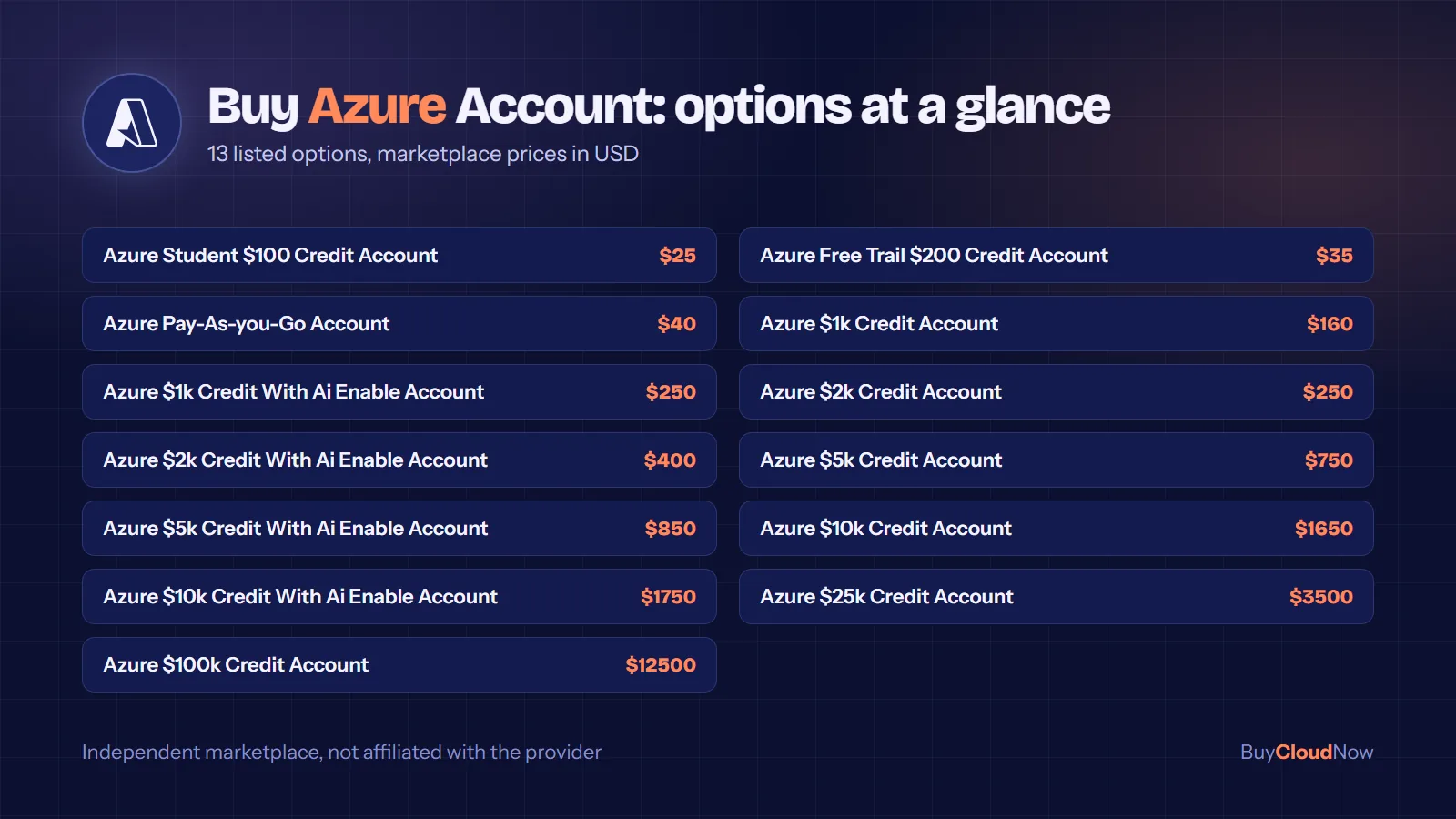
Buy Azure Account listings on this marketplace cover thirteen Microsoft Azure configurations, from a $25 student credit account to $100k credit tiers, several of them with AI services enabled.
Every option is listed with its USD price so you can match an Azure cloud account to the workload before you commit. This page explains what each configuration means, who it suits, and what to check first.
These are the 13 options currently listed for Buy Azure Account, with the marketplace price for each. Prices are in US dollars and apply to the listing itself; the provider’s own usage charges apply separately under its terms of service.
Select an option in the purchase panel at the top of this page to see its price update, then add it to the cart. If you need a configuration that is not listed, message the team through the contact page.
Accessing Microsoft’s cloud platform quickly and reliably matters for teams that need compute, storage, AI services, or infrastructure without lengthy setup delays. Whether you are spinning up development environments, running production workloads, training models, or hosting applications, an Azure Cloud Account provides the foundation for those activities. At BuyCloudNow.com we focus on helping developers, startups, agencies, researchers, SaaS teams, and established businesses locate suitable Azure options that match their project requirements and timelines.
This page explains what an Azure Cloud Account involves, the different configurations people commonly seek, practical use cases, important buying considerations, and answers to frequent questions. The goal is to give you clear, useful information so you can decide whether purchasing an account aligns with your needs.
Microsoft Azure is a comprehensive cloud platform that offers virtual machines, managed databases, AI and machine learning services, networking, storage, security tools, and hundreds of other services. An Azure account is the entry point that lets you sign in to the Azure portal, create subscriptions, provision resources, manage billing, and control access through Microsoft Entra ID (formerly Azure Active Directory).
Accounts can vary widely in configuration. Some are newly created pay-as-you-go subscriptions. Others come with promotional or remaining credits that can offset usage costs for a period. Certain accounts may already have elevated quotas for virtual machines, GPU-accelerated instances, or specific regions. Still others are structured for particular workloads such as development and testing, AI experimentation, or production hosting.
When people search for ways to Buy Azure Account options, they are often looking for ready-to-use access that reduces the friction of identity verification, credit-card setup, or waiting for quota increases. An Azure Account for Sale in the secondary market can sometimes provide that faster path, provided the buyer performs proper due diligence around ownership transfer, remaining credit balances, and compliance with Microsoft’s terms.
Buy Microsoft Azure Account offerings typically fall into several practical categories:
Each type serves different priorities. A team focused on cost control may prioritize remaining Azure Cloud Credits. A researcher training large models may look for an Azure GPU Account with appropriate regional availability and quota. A startup building a new SaaS product may value an Azure Account for Developers that already has basic networking and identity configured.
Creating an Azure free account or pay-as-you-go subscription directly through Microsoft is straightforward for many users. It usually requires a phone number, a non-prepaid payment method, and a Microsoft or GitHub identity. New customers often receive a limited promotional credit and monthly free tiers for selected services. However, real-world constraints appear quickly:
In these situations, looking for an Azure Account for Sale becomes a practical alternative for some buyers. An Azure Credit Account that already carries a usable balance can accelerate experimentation. An Azure VPS Account or Azure Virtual Machine Account that has previously been approved for higher compute quotas can shorten the time between purchase and first deployment.
BuyCloudNow.com serves as a marketplace-oriented destination where visitors can explore available cloud-account options, including those related to Azure. The site aims to connect buyers with listings that match stated requirements around credits, region, or workload type.
One of the most frequent requests is an Azure Account with Credits. Credits reduce the immediate cash outlay for compute, storage, networking, and many platform services. An Azure Credit Account may carry a remaining balance from a previous promotional offer, a startup program, a Visual Studio subscription allocation, or another legitimate source.
When evaluating such an account, buyers typically examine:
Buy Azure Credits in the form of a pre-funded account can be useful for short-term projects, proof-of-concept work, or bridging a gap until a larger enterprise agreement is negotiated. Azure Cloud Credits function as a prepaid pool that is drawn down as resources run. Once the balance reaches zero, the subscription continues under standard pay-as-you-go rates if a valid payment method is attached.
It is essential to understand that credits are not universal currency. Certain offers exclude Azure Marketplace purchases, support plans, or specific AI models billed outside the core Azure meter. Always verify coverage against the services you intend to run.
Many buyers specifically seek an Azure VPS Account or Azure Virtual Machine Account. These terms generally refer to accounts that already have the ability to create and run virtual machines without immediate quota barriers. An Azure VM Account may have previously requested and received increases for particular VM families or regions.
Azure Virtual Machines support a wide range of operating systems, sizes, and specialized hardware. Common families include:
An Azure VPS Account can simplify the process of standing up development, staging, or production servers. Buyers often look for accounts that already have:
Because VM pricing is usage-based (or can be optimized with reserved instances and savings plans), an account that already carries some Azure Cloud Credits can further reduce early costs while the team validates performance and cost models.
Artificial intelligence and machine-learning workloads have become major drivers of Azure adoption. An Azure AI Account typically provides access to Azure Machine Learning, Azure AI services (formerly Cognitive Services), Azure OpenAI Service where available, and related tools. An Azure GPU Account focuses on the underlying accelerated compute: NC-series, ND-series, and other GPU-enabled virtual machine families powered by NVIDIA GPUs.
Training large models or running inference at scale requires both the software platform and the hardware capacity. Quotas for GPU VMs are often set to zero by default on new subscriptions and must be raised through support requests. An Azure GPU Account that already possesses approved quota in relevant regions can save days or weeks of waiting.
Key points buyers evaluate for these specialized accounts include:
Because GPU and AI services can consume credits rapidly, pairing an Azure AI Account or Azure GPU Account with a meaningful credit balance is a common preference.
For teams focused on web applications, APIs, or traditional server workloads, an Azure Hosting Account or Azure Server Account offers a familiar model. These accounts support App Service, Azure Kubernetes Service, Container Instances, virtual machines, and related networking components.
An Azure Infrastructure Account provides broader control over the underlying resources: virtual networks, load balancers, firewalls, storage accounts, and identity. An Azure Compute Account emphasizes the compute layer itself—virtual machines, scale sets, and container platforms.
When choosing among these, consider:
Azure Cloud Account Online listings on marketplaces often highlight these infrastructure-oriented configurations so buyers can match the account to their architecture style.
Developers frequently need isolated environments for experimentation, continuous integration pipelines, or feature branches. An Azure Account for Developers can serve as a personal or team sandbox that is separate from production billing. Features that matter in this context include:
Microsoft offers monthly Azure credits to Visual Studio subscribers, and startups can sometimes access larger credit pools through official programs. When those official channels are unavailable or insufficient, an Azure Account for Developers sourced through a marketplace can fill the gap, provided the transfer of ownership is handled cleanly.
Startups and early-stage SaaS teams often need to validate product ideas quickly. An Azure Account with Credits lets them provision databases, app services, and AI endpoints while controlling cash burn. Once the product-market fit is clearer, they can migrate to a longer-term agreement or reserved capacity.
Agencies and consultancies manage multiple client projects. Separate Azure Cloud Account instances help isolate billing and access. An Azure Hosting Account or Azure Server Account can be assigned to a specific engagement and transferred or closed when the project ends.
Researchers and academic groups frequently require burst capacity for simulations or model training. An Azure GPU Account with remaining credits can support a research cycle without long procurement cycles.
Established businesses may need temporary additional capacity during peak periods, migrations, or disaster-recovery testing. An Azure Infrastructure Account that already has elevated quotas reduces the risk of delays.
Individual developers and freelancers sometimes prefer an independent Azure Cloud Account Online rather than relying on an employer’s tenant. This keeps personal projects cleanly separated and portable.
Purchasing any cloud account from a third party carries responsibilities and risks that buyers must evaluate carefully.
Ownership and transfer process
Confirm how login credentials, recovery email or phone, and billing ownership will be transferred. Microsoft provides documented processes for changing billing ownership of subscriptions in many cases. Understand whether the seller will assist with the formal transfer or simply hand over credentials.
Credit authenticity and remaining balance
Request clear evidence of the current credit balance and its terms. Credits can have expiration dates or usage restrictions. An Azure Credit Account is only as useful as the balance that remains after transfer.
Quota and regional availability
Verify that the account can create the VM sizes, GPU types, or AI services you need in the regions that matter to you. Quota is subscription- and region-specific.
Compliance and terms of service
Microsoft’s terms generally discourage unauthorized account transfers. Buyers should review the current Microsoft Customer Agreement and subscription terms. Using accounts obtained through fraudulent means (stolen payment methods, false identities) creates legal and operational risk. Stick to transparent, verifiable sources.
Security posture
Change all passwords, enable multifactor authentication, review role assignments, and audit existing resources immediately after taking ownership. Remove any unknown applications or service principals.
Billing continuity
Ensure a valid payment method can be attached so services continue once credits are exhausted. Understand the current spending limit settings.
Support eligibility
Determine whether the account still qualifies for Microsoft support plans and how support requests will be handled after transfer.
These steps help protect both the buyer and the integrity of the Azure platform.
Azure pricing is primarily consumption-based. Virtual machines are billed by the second or minute depending on the series. Storage, networking, databases, and AI services each have their own meters. Cost-management tools inside the Azure portal allow budgets, alerts, and detailed usage analysis.
Optimization options include:
An account that already carries Azure Cloud Credits gives a temporary buffer while these longer-term optimizations are implemented.
Following a structured evaluation reduces the chance of surprises after the account is in your control.
It usually refers to obtaining a Microsoft Azure subscription and associated identity that is ready for resource creation, sometimes with remaining promotional or prepaid credits. Buyers may seek faster access than the standard self-service sign-up provides.
No. Official free accounts are created directly through Microsoft and come with specific promotional terms. Marketplace accounts vary in history, credit balance, and configuration.
Some listings are positioned as Azure GPU Account offerings that have previously received quota increases for GPU-enabled virtual machine families. Always confirm current quota status in the regions you need.
Confirm the exact remaining balance, the date the credits were issued or last refreshed, any expiration, and which services they can be applied to. Also verify that the account has not already exhausted the credits.
The term Azure VPS Account is commonly used for accounts oriented toward virtual-machine workloads, often with elevated compute quotas already in place. Functionally it is still an Azure subscription, but the configuration may favor VM creation.
Credits remain tied to the subscription. When billing ownership of the subscription is properly transferred, the remaining eligible credits generally stay with that subscription, subject to the original offer terms.
These phrases are used interchangeably by buyers searching for accounts suited to running virtual machines. Focus on the actual quota and regional availability rather than the marketing label.
Access to Azure OpenAI Service is controlled by Microsoft and may require a separate application or approval even on an existing subscription. Confirm current eligibility after transfer.
BuyCloudNow.com operates as an independent marketplace for cloud-related accounts and services. Buyers should perform their own due diligence on any listing.
If a valid payment method is attached, the subscription continues under standard pay-as-you-go pricing. Without a payment method, resources may be suspended according to Microsoft’s policies.
Once credentials are transferred and you have secured the account, you can typically begin creating resources immediately, subject to existing quotas and any regional restrictions.
Most transfers keep the existing directory. Changing tenants is a more complex process and may not be supported in all cases. Clarify this point before purchase.
Yes. Azure supports a broad range of Windows Server and Linux distributions on virtual machines and on managed platforms such as App Service and Azure Kubernetes Service.
Request screenshots or exports showing current credit balance, subscription type, available regions, and any elevated quotas. Also ask for confirmation that the account was created through legitimate channels.
These are overlapping search phrases. Both refer to accounts accessible via the Azure portal and Azure APIs. Focus on the concrete attributes of the listing rather than the exact wording.
Use these pages to compare providers, read background guides, and check the questions other buyers ask before deciding to buy azure account.
For platform features, quotas and current provider terms, the authoritative source is the official Microsoft Azure documentation. Buy Cloud Now is an independent marketplace and is not affiliated with the provider.
Choosing to Buy Azure Account access is a practical decision for many teams facing time, quota, or credit constraints. The value lies in matching the account’s actual capabilities—credits, quotas, regional presence, and configuration—to your specific workloads. An Azure Account for Sale can accelerate projects when the transfer is transparent and the remaining resources are clearly documented.
At the same time, responsible buyers treat every transaction with the same care they would apply to any significant infrastructure decision. Verify ownership, secure the account immediately, attach your own billing controls, and operate within Microsoft’s terms.
Whether you need an Azure Compute Account for general workloads, an Azure Infrastructure Account for complex networking, an Azure Server Account for traditional hosting, or a specialized Azure GPU Account or Azure AI Account, the key is clarity about what you are acquiring and how you will manage it going forward.
If you are ready to explore current options that align with your requirements, visit the listings available through BuyCloudNow.com and review the details of each Azure Cloud Account carefully. Clear communication with the seller and thorough post-purchase security steps will help you move from acquisition to productive use with confidence.
Azure continues to evolve with new services, regions, and pricing models. Staying informed about official Microsoft documentation, cost-management best practices, and security recommendations remains the most reliable way to extract long-term value from any account you operate.
Breadth of services, global reach, and mature tooling around compute, storage, databases, and serverless options.
Data analytics, machine-learning tooling, Kubernetes-native experiences, and specific regional strengths.
Hybrid capabilities, enterprise features, and VPC-centric infrastructure.
Short answers from the Cloud FAQ hub for this provider, with links to the full set.
All Azure questionsAzure is Microsoft’s cloud platform. It offers virtual machines, managed databases, AI and machine-learning services, networking, storage and security tools, with identity handled through Microsoft Entra ID. Organizations that already use Microsoft productivity or directory services tend to choose it for that integration, along with hybrid connectivity to on-premises systems.
The Buy Azure Account listings on this marketplace are typically used by developers wanting an isolated sandbox, startups and SaaS teams validating a product, agencies isolating client billing, researchers who need GPU capacity backed by credits, and established businesses that need temporary extra capacity. See the Buy Azure Account page, and compare it with the other hyperscalers in AWS vs Azure vs Google Cloud accounts.
The Buy Azure Account page lists three families. Entry options: Azure Student $100 Credit Account at $25, Azure Free Trail $200 Credit Account at $35, and Azure Pay-As-you-Go Account at $40, which carries no credit and bills usage to your payment method.
Standard credit tiers: Azure $1k Credit Account at $160, Azure $2k Credit Account at $250, Azure $5k Credit Account at $750, Azure $10k Credit Account at $1650, Azure $25k Credit Account at $3500 and Azure $100k Credit Account at $12500. AI-enabled tiers for teams using Azure AI services: Azure $1k Credit With Ai Enable Account at $250, $2k at $400, $5k at $850 and $10k at $1750. See the Buy Azure Account page, and Azure credit accounts with AI enabled for what the AI tiers change.
Check four things in the Azure portal before you deploy. Billing: confirm the exact remaining credit balance, its expiry date, whether a spending limit is active, and whether the subscription has already converted to pay-as-you-go. Credit coverage: Azure credits generally apply to core consumption meters but often exclude Marketplace items, support plans and some AI models billed separately, so confirm the services you intend to run are eligible.
Quotas: VM core quotas are set per subscription and per region, and GPU families frequently start at zero. Regions: make sure the sizes you need are available where you must deploy. Finally, read the current Microsoft Customer Agreement so you operate within it. Start on the Buy Azure Account page, then follow cost control for new cloud accounts.
Three layers are easy to confuse. The tenant is the Microsoft Entra ID directory that holds users, groups and app registrations; it is the identity boundary. The account is the sign-in identity that belongs to that directory and can own billing. A subscription is the billing and resource container inside a tenant: resources live in resource groups within a subscription, and quotas, credits and invoices are tracked per subscription.
A listed option such as the Azure $5k Credit Account is really a subscription carrying a credit balance. When ownership changes, most transfers keep the existing tenant; moving a subscription between tenants is a separate, more involved process. Read Azure subscriptions, accounts and tenants, then view the Buy Azure Account listings.
Azure fits best where Microsoft integration matters. Enterprises already running Microsoft 365, Windows Server, SQL Server or Entra ID get single sign-on, hybrid networking and licensing benefits that other clouds cannot replicate. .NET and Windows-centric development teams find App Service, Azure Kubernetes Service and Visual Studio integration natural.
AI and research groups use Azure Machine Learning, Azure AI services and GPU VM families, which is why the AI-enabled credit tiers exist on the listing. Agencies use separate subscriptions to isolate client billing. It is a heavier platform than a developer-focused VPS provider, so a solo developer running a few servers may prefer a simpler cloud. Explore the Buy Azure Account page, or weigh the alternatives in Kamatera vs Azure accounts.
Select an option above to add it to your cart, or message the team for a custom configuration.