OVHcloud
Buy OVH Account
European infrastructure with a broad product range from dedicated servers to public cloud.
From $30
2 options
European cloud infrastructure has earned a strong following among technical teams that value transparent pricing, solid hardware, and straightforward operations.
Independent listing. Prices shown are the marketplace prices for each option; the provider's own usage charges apply separately under its terms.
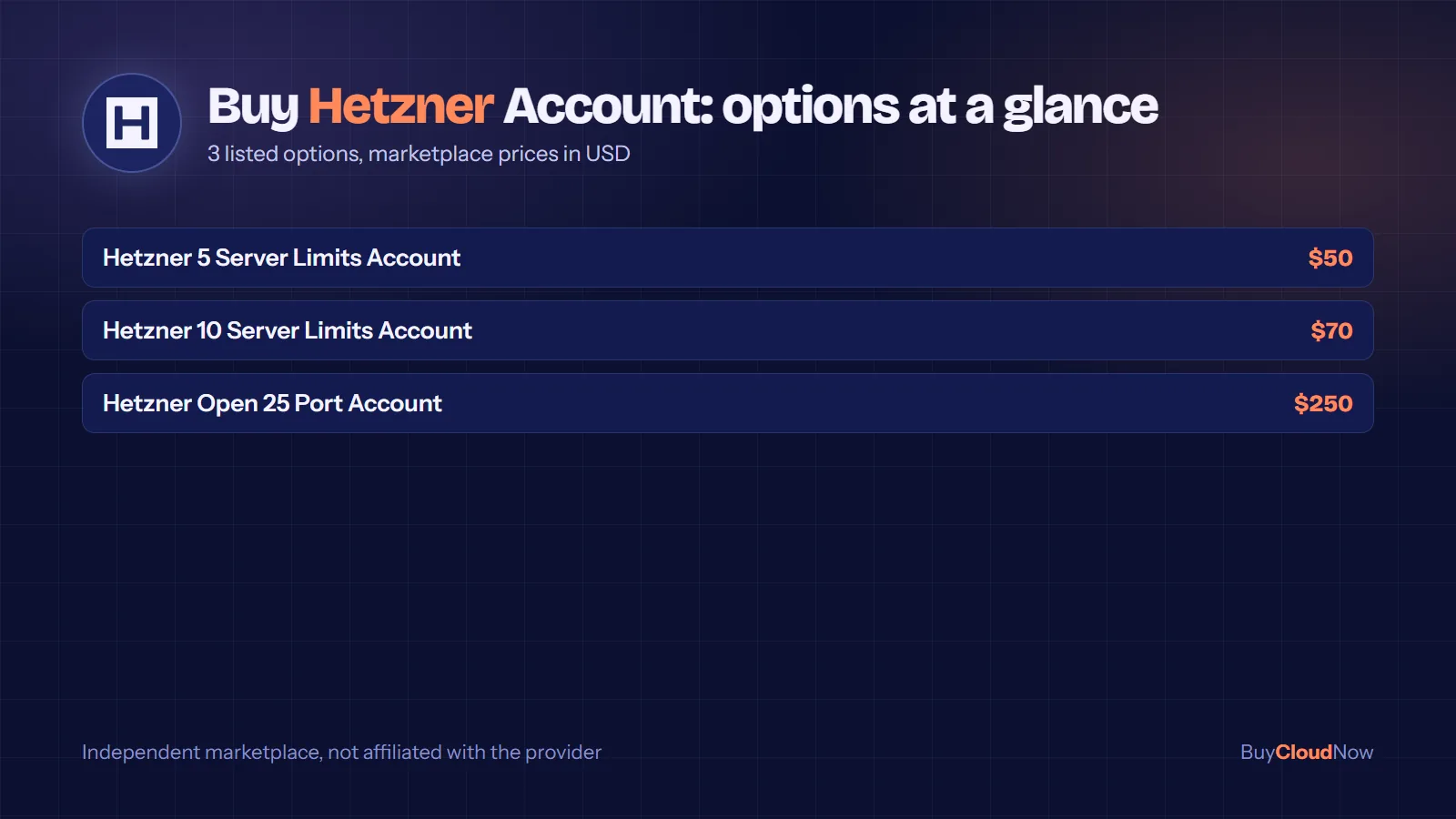
Buy Hetzner Account listings are organised around server limits: a 5 Server Limits Account at $50, a 10 Server Limits Account at $70, and an Open 25 Port Account at $250.
Hetzner is valued for European data centers and strong price-to-performance. This page explains the listed options, the platform, and the operational practices that support reliable use.
These are the 3 options currently listed for Buy Hetzner Account, with the marketplace price for each. Prices are in US dollars and apply to the listing itself; the provider’s own usage charges apply separately under its terms of service.
Select an option in the purchase panel at the top of this page to see its price update, then add it to the cart. If you need a configuration that is not listed, message the team through the contact page.
European cloud infrastructure has earned a strong following among technical teams that value transparent pricing, solid hardware, and straightforward operations. Hetzner, a long-established German provider, operates its own data centers and offers both virtual cloud servers and dedicated hardware. Many developers, startups, and agencies evaluate the option to Buy Hetzner Account access when they need reliable compute without the complexity or cost structure of larger hyperscale platforms.
The platform covers virtual machines with shared or dedicated resources, ARM-based instances, physical dedicated servers, storage options, and networking features such as private networks, load balancers, and firewalls. This range supports everything from lightweight development environments to production applications and more demanding workloads. This page examines practical aspects of choosing and using Hetzner resources, focusing on real operational considerations rather than marketing language.
Hetzner Online has built its reputation around owning and operating its infrastructure. Data center locations include sites in Germany and Finland, with additional presence in the United States and Singapore. This geographic footprint allows teams to place workloads closer to European users while still reaching other regions when needed.
The service model is largely self-managed. Users receive root or full administrative access and remain responsible for operating-system maintenance, security configuration, application deployment, and monitoring. This approach appeals to teams that already have technical capacity and prefer direct control over managed convenience.
Billing for cloud instances is typically hourly with a monthly cap, so short-lived environments do not accumulate unnecessary cost. Dedicated servers follow a more fixed monthly model. Generous included traffic allowances in many locations further reduce surprise charges for bandwidth-intensive applications.
When teams decide to Buy Hetzner Account capacity, they often do so because the combination of hardware value, regional coverage, and operational simplicity aligns with their priorities. The decision is usually driven by specific project needs rather than brand familiarity alone.
Understanding the main product lines helps match resources to workloads.
Hetzner Cloud provides virtual machines that can be provisioned quickly through a web console or API. These instances come in shared-resource and dedicated-resource variants. Shared instances suit development, testing, and applications that tolerate variable performance. Dedicated-resource instances allocate exclusive CPU capacity, offering more predictable behavior for production or CPU-intensive tasks.
ARM-based options deliver efficient price-to-performance for compatible Linux workloads. Storage is typically local NVMe, with the ability to attach additional volumes. Snapshots, backups, floating IPs, and private networks extend the basic compute offering into more complete environments.
A Hetzner VPS Account or Hetzner Cloud Server Account commonly starts with these virtual machines. They form a practical foundation for websites, APIs, staging systems, and smaller production services.
For workloads that benefit from exclusive hardware, Hetzner offers dedicated root servers. These provide full access to the physical machine, including all CPU cores, memory, and local storage. Configurations range from mid-range options suitable for databases or application servers to higher-core-count systems for heavier processing.
Auction or previously used servers sometimes appear at lower monthly rates, giving cost-conscious teams access to substantial resources. Newer standard configurations prioritize recent processor generations and faster storage. A Hetzner Dedicated Server Account or Hetzner Dedicated Server Online setup is often chosen when consistent performance and isolation matter more than rapid scaling.
Certain configurations include graphics processors suited to rendering, inference, or other accelerated tasks. Availability and models vary, so teams needing a Hetzner GPU Account typically verify current offerings and regional stock before planning deployments. These resources are generally provided as dedicated hardware rather than shared cloud slices.
Some users treat Hetzner primarily as a hosting platform for websites or applications. In these cases a Hetzner Hosting Account or Hetzner Cloud Hosting Account supplies the underlying compute and storage while the software stack is managed independently. Others build more complete platforms that combine compute, storage, networking, and orchestration under a single Hetzner Infrastructure Account or Hetzner Cloud Infrastructure Account.
A Hetzner Compute Account typically refers to the virtual or physical compute layer that runs application code and supporting services. The same account can often host multiple projects when proper isolation practices are followed.
Several characteristics make Hetzner attractive for specific audiences.
Price-to-performance remains a frequent reason teams look for a Hetzner Account for Sale. Competitive rates combined with modern processors and NVMe storage allow substantial resources to be obtained within modest budgets. This is especially relevant for startups, independent developers, and agencies managing multiple client environments.
European data residency and network proximity benefit applications serving users in Germany, the broader EU, or nearby regions. Teams with compliance or latency requirements often find the German and Finnish locations useful.
API and automation support enable infrastructure-as-code practices. Terraform providers, CLI tools, and a REST API allow scripted creation, configuration, and teardown of resources. This fits continuous-integration pipelines and dynamic environments well.
Full administrative access gives complete freedom over the software environment. Preferred operating systems, custom kernels, specialized drivers, or particular security tools can be installed without platform restrictions. The corresponding responsibility for maintenance and hardening remains with the account holder.
For budget planning, a Hetzner Account with Credits or a Hetzner Credit Account can help. Prepaid balances allow spending to be controlled in advance. When the need arises to Buy Hetzner Credits, understanding how those credits apply across product categories supports clearer financial tracking.
Different user groups approach the platform with distinct goals.
Developers and individual engineers often value rapid provisioning of virtual machines, root access, and the ability to experiment without long-term commitments. A Hetzner Account for Developers supports side projects, learning environments, portfolio sites, and early prototypes.
Startups and early-stage companies frequently need to stretch limited budgets while still delivering acceptable performance and regional reach. Flexible cloud instances combined with the option to move to dedicated hardware later provide a growth path.
Agencies and freelancers managing client work benefit from the ability to isolate environments and control costs per project. Clear naming, private networks, and snapshot practices help maintain professional separation between clients.
SaaS and product teams may use Hetzner for application tiers, supporting services, or cost-sensitive components of a larger architecture. Some combine Hetzner resources with other providers for multi-cloud resilience.
Researchers and technical specialists running compute-heavy or data-processing jobs sometimes turn to dedicated servers or GPU configurations for sustained performance at controlled cost.
In each case the decision to Buy Hetzner Cloud Account access is driven by a concrete match between available hardware, operational model, and project constraints.
Several practical questions deserve attention before acquiring resources.
Workload characteristics should guide the choice between shared cloud instances, dedicated-resource cloud instances, and physical dedicated servers. Variable or bursty traffic often suits cloud virtual machines. Sustained high utilization or strict isolation requirements may favor dedicated hardware.
Geographic placement affects both latency and data-location preferences. Testing connectivity from target user locations and confirming any residency requirements helps narrow the options.
Operational capacity is equally important. Because the service is largely unmanaged, the team must handle system updates, security configuration, backup strategy, and monitoring. Existing skills and tooling should be assessed honestly.
Billing model alignment matters. Hourly cloud billing with a monthly ceiling suits temporary or elastic workloads. Fixed monthly dedicated-server pricing favors steady utilization. Prepaid options such as a Hetzner Credit Account can further support budget discipline. Planning when and how to Buy Hetzner Credits avoids interruptions caused by depleted balances.
Integration with existing tools and workflows should be reviewed. Compatibility with preferred operating systems, configuration management, container platforms, and monitoring solutions reduces friction during adoption.
Growth and change planning prevents future constraints. The ability to resize cloud instances, attach additional storage, or migrate between regions supports evolving needs. Snapshot and image practices accelerate consistent environment creation as the number of servers increases.
Concrete scenarios help clarify how different account types are applied.
A freelance developer maintaining several client websites may operate multiple modest cloud instances under one Hetzner VPS Account. Each site runs in its own environment, and resources can be adjusted as traffic changes.
A startup launching an early product version might begin with a small set of cloud servers for the application and database layers. As traffic grows, vertical upgrades or additional instances can be introduced. Later stages may incorporate dedicated servers for components that benefit from exclusive hardware.
An agency handling temporary campaign sites can provision short-lived cloud environments, deploy the required stack, and remove the resources once the campaign ends. Hourly billing keeps costs aligned with actual duration.
A team running continuous-integration pipelines can spin up temporary instances for test environments, destroy them after the pipeline completes, and keep baseline infrastructure lean. Automation through the API makes this pattern efficient.
A research group needing sustained compute for data processing or model work may select a dedicated server or GPU-equipped configuration. Predictable monthly cost and exclusive access to hardware support longer-running jobs.
In all of these situations the choice to Buy Hetzner Account resources rests on matching hardware characteristics and operational model to the actual work being performed.
Beyond the initial selection of resources, day-to-day practices determine long-term success.
Snapshot schedules capture the state of important instances and enable rapid recovery or cloning. Regular snapshots form a basic safety net against configuration errors or data issues.
Additional block storage volumes can be attached and resized independently, providing flexible capacity for growing datasets without rebuilding entire servers.
Private networks allow secure communication between instances without exposing internal traffic to the public internet. Combined with firewall rules, they support cleaner network segmentation.
Floating IP addresses enable traffic to be redirected between servers with minimal disruption, useful during maintenance or failover scenarios.
Monitoring should cover CPU, memory, disk, and network metrics at minimum. External tools or platform features can supply alerts when thresholds are crossed.
Backup strategies need explicit definition. Whether using snapshots, external backups, or application-level replication, a tested recovery process protects against loss.
Access control practices—strong authentication, limited API tokens, and careful permission assignment—reduce risk. Multi-factor authentication where available adds an important layer.
Documentation of the environment (instance types, regions, networking layout, recovery steps) prevents knowledge from remaining siloed with a single team member.
Some organizations prefer prepaid models for clearer budget control. A Hetzner Account with Credits allows funds to be deposited and then consumed as services are used. This can simplify expense tracking for projects with fixed allocations or for temporary experimental work.
A Hetzner Credit Account functions in a similar way, providing a balance that can be drawn down across eligible products. When planning to Buy Hetzner Credits, it is useful to confirm which services accept credit balances and any applicable terms. Monitoring remaining balance and understanding consumption rates helps avoid unexpected service interruptions.
Combining credit-based access with internal policies around resource creation and deletion encourages responsible usage and cost awareness.
A structured evaluation reduces uncertainty.
Document the primary workload and its resource profile. Estimate CPU, memory, storage, and network needs under expected conditions. Distinguish between average and peak demand.
Identify geographic priorities. List the regions that matter for latency, compliance, or redundancy. Verify current availability of preferred instance types in those locations.
Review the available families—shared cloud, dedicated-resource cloud, ARM options, and physical dedicated servers—and note which align with the resource profile and operational preferences.
Assess team readiness for self-managed infrastructure. Confirm skills and tooling for system administration, security, backups, and monitoring, or identify gaps that need to be addressed.
Decide on a billing approach. Determine whether hourly cloud billing, fixed dedicated-server pricing, or a credit-based model best fits the project’s financial practices. If credits are preferred, plan the process to Buy Hetzner Credits and monitor their use.
Start with a non-production environment whenever possible. Deploy a representative workload, measure performance and cost, and refine the configuration before moving critical services.
Document everything of operational importance so that the environment remains maintainable as the team or project evolves.
Revisit resource choices periodically. Cloud and dedicated infrastructure both benefit from ongoing attention to right-sizing and cost efficiency.
Clarify the workload characteristics, preferred regions, and the team’s capacity to manage systems, security, and backups. Understanding the self-managed nature of the service helps set realistic expectations.
Differences often appear in hardware value, European data-center presence, traffic allowances, and the balance between cloud flexibility and dedicated-server economics. Evaluating these factors against concrete project needs produces more useful comparisons than generic feature lists.
Many teams run production workloads successfully. Suitability depends on matching instance characteristics to the application, implementing solid operational practices, and planning for recovery and redundancy.
A Hetzner VPS Account or cloud instance runs on shared physical hosts (or dedicated vCPU slices). A Hetzner Dedicated Server Account provides exclusive access to the entire physical machine. The choice depends on isolation, performance consistency, and cost structure preferences.
When the workload benefits from graphics-processor acceleration for rendering, inference, or related tasks. Confirming current models, availability, and regional stock is part of the evaluation.
Credits can be applied to an account and consumed as eligible services are used. This prepaid approach supports budget control for defined or temporary projects. When planning to Buy Hetzner Credits, review applicable terms regarding product eligibility.
Yes. Multiple instances can be deployed under a single account. Using private networks, firewalls, and clear naming conventions helps maintain isolation and operational clarity.
The account holder typically manages operating-system updates, security configuration, application deployment, backups, and monitoring. The platform supplies the underlying infrastructure and basic management tools.
Location affects latency for end users and can influence data-residency considerations. Selecting regions close to the primary audience and verifying network performance improves the overall experience.
The underlying platform is the same. The distinction lies mainly in usage patterns—developers often prioritize rapid iteration, API access, and frequent creation and deletion of environments.
Think about the full set of services the project may need—compute, storage, networking, and possibly orchestration. An infrastructure-oriented approach can support more complete architectures while keeping management centralized.
It provides the compute and storage foundation for websites or applications while the software stack is managed independently. This model works well for teams that already have established deployment and maintenance practices.
Yes. Prepaid credits can limit financial exposure and simplify accounting for temporary environments or experimental workloads whose duration is known in advance.
It usually supplies the virtual or physical machines that run application code and supporting services. These resources form the core compute layer of most deployments.
When the workload benefits from exclusive hardware or higher performance consistency than shared cloud instances typically provide. Dedicated configurations often fall into this category.
Treat each client environment with clear isolation, documentation, and recovery procedures. Consistent naming, snapshot schedules, and access controls help maintain professionalism and reduce operational risk.
Use these pages to compare providers, read background guides, and check the questions other buyers ask before deciding to buy hetzner account.
For platform features, quotas and current provider terms, the authoritative source is the official Hetzner documentation. Buy Cloud Now is an independent marketplace and is not affiliated with the provider.
Selecting cloud or dedicated resources is fundamentally an exercise in matching capabilities to requirements. A clear understanding of workload demands, geographic needs, operational readiness, and cost structure leads to better outcomes than focusing solely on headline specifications.
The option to Buy Hetzner Account capacity gives access to a platform that many technical teams find effective for development, production, and specialized workloads. Whether the immediate need is a modest virtual machine, a set of dedicated-resource instances, physical dedicated servers, or a broader infrastructure arrangement, careful evaluation of both capabilities and responsibilities supports confident choices.
Teams that define their requirements clearly, test representative configurations, and establish disciplined operational practices are better positioned to extract lasting value from the resources they provision. Infrastructure works best when treated as a flexible tool rather than a set-and-forget commodity.
For those ready to explore further, reviewing current instance and server options, regional availability, and billing models in light of specific project goals remains the most reliable path. Clear planning and realistic expectations around management responsibilities help ensure that the chosen resources support the work rather than complicate it.
At BuyCloudNow.com the emphasis stays on connecting users with practical cloud and dedicated-server options that align with real technical needs. Thoughtful selection and responsible usage of infrastructure continue to form the foundation of successful projects across development, business, and research contexts.
When capacity needs change, the same principles apply: match resources to demand, maintain operational discipline, and keep cost visibility high. A well-managed Hetzner Cloud Account or related configuration can serve as a durable component of a broader technology stack for as long as the underlying requirements remain relevant.
BuyCloudNow.com supports users seeking straightforward access to European-rooted cloud and dedicated infrastructure that prioritizes performance, value, and clear operational characteristics. By approaching the decision with a solid understanding of both the available resources and the responsibilities that accompany them, teams can make choices that support their goals over the long term.
Whether the next step involves a basic virtual private server, dedicated hardware, accelerated configurations, or a more complete infrastructure setup, the most valuable preparation remains a clear picture of the work the resources will perform and the practices that will keep them reliable and cost-effective.
European infrastructure with a broad product range from dedicated servers to public cloud.
European data residency, developer-friendly tooling, and a mix of compute, storage, and related services.
Global data-center coverage, flexible compute including GPU options, and a developer-oriented control plane.
Short answers from the Cloud FAQ hub for this provider, with links to the full set.
All Hetzner questionsHetzner Online is a long-established German provider that owns and operates its own data centers, with sites in Germany and Finland plus presence in the United States and Singapore. It offers cloud virtual machines with shared or dedicated vCPUs, ARM-based instances, physical dedicated servers, storage and networking features such as private networks, load balancers and firewalls.
Technical teams like it for transparent pricing, solid hardware, hourly cloud billing with a monthly cap, and generous included traffic in many locations. The trade-off is a self-managed model: you get root access and handle updates, security, backups and monitoring yourself. The Buy Hetzner Account page lists the marketplace options, and Hetzner vs OVH vs Scaleway compares it with two other European providers.
Three Hetzner options are listed on the marketplace. The Hetzner 5 Server Limits Account at $50 and the Hetzner 10 Server Limits Account at $70 are defined by the number of cloud servers the account can run at once: five or ten. The Hetzner Open 25 Port Account at $250 is defined by outbound port 25 being open, the port used for SMTP mail delivery, which providers commonly restrict on new accounts.
Pick the server-limit option that matches the deployment you plan, and consider the port 25 option only if you run legitimate mail infrastructure within Hetzner’s terms. In every case confirm the limit or port status in the console after access. See Buy Hetzner Account and the Hetzner server limits explainer.
Like most cloud providers, Hetzner gives each new account a ceiling on how many cloud servers it can create. Limits protect the platform against abuse and runaway spending from unproven accounts, and they are typically raised as an account builds a history of normal use and paid invoices. A limit request through the console is the usual route when you need more capacity, and Hetzner decides case by case.
For planning, treat the limit as the maximum concurrent servers, not a monthly quota: deleting a server frees its slot. If you expect to exceed the current ceiling soon, request an increase early rather than on launch day. The quotas explainer covers why new accounts start small, and the Hetzner account page lists the 5 and 10 server limit options.
Confirm the operational facts in the console: the current server limit, which locations (Germany, Finland, United States, Singapore) are available, and whether the instance types you plan to use, including dedicated vCPU or ARM options, are in stock there. Understand the billing model: cloud instances are hourly with a monthly cap, dedicated servers are fixed monthly, and traffic allowances differ by location.
Then secure the account: change the password, enable multi-factor authentication, rotate API tokens and SSH keys, review existing projects and servers, and attach your own payment method. Read Hetzner’s terms of service. Because the service is self-managed, put backups, firewalls and monitoring in place before traffic arrives. The backup and recovery baseline uses Hetzner as an example, and the Buy Hetzner Account page lists the options.
Hetzner is a frequent choice for bootstrapped startups because hardware value, hourly billing with a monthly cap and included traffic stretch a small budget, and the option to move steady workloads onto dedicated servers later keeps costs predictable as the product grows. Research teams use it for compute-heavy jobs on dedicated hardware and for GPU models where available, with European locations supporting data-residency needs.
Developers use it for rapid iteration through the API, and agencies isolate client work with separate projects and firewalls. The condition in every case is technical capacity: the platform is self-managed. If your team wants managed databases and a large service catalog, a hyperscaler may fit better. Startup infrastructure in the first 90 days sequences those decisions, and the Buy Hetzner Account page lists the options.
Select an option above to add it to your cart, or message the team for a custom configuration.